People should be able to describe outcomes without learning every interface required to produce them.
Why Nexus exists
AI learned to understand us. Nexus gives it a controlled way to work for us.
AI reached a remarkable point: it could understand complicated requests, reason about problems, write software, analyse enormous amounts of information and explain exactly what needed to happen. Yet the process still ended remarkably often by handing the procedure back to the person.
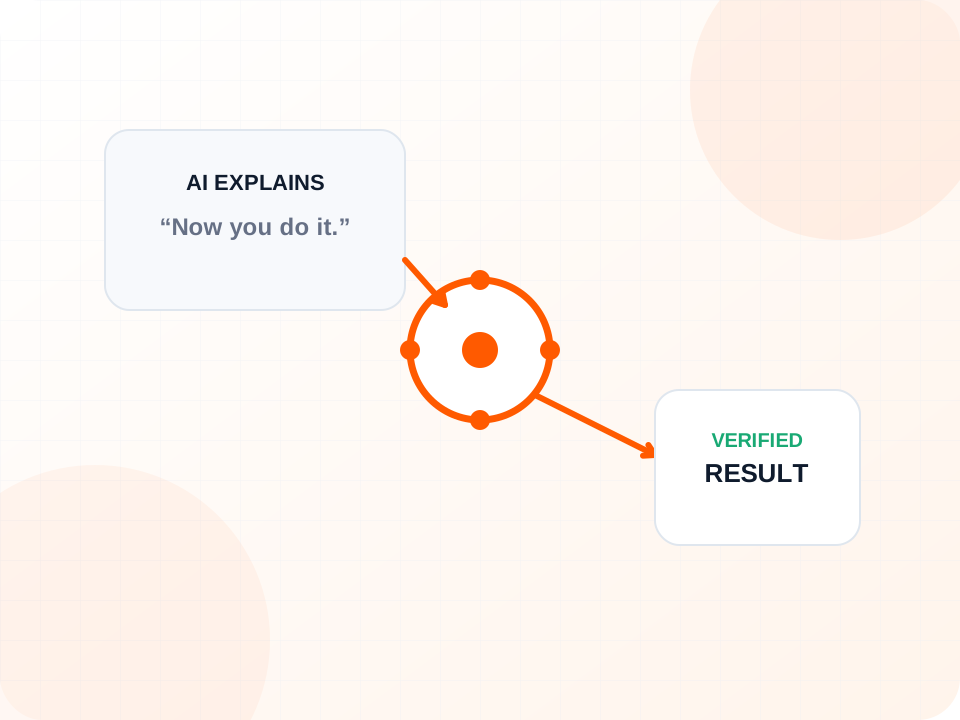
The gap
The intelligence existed. The software existed. The tools existed.
What remained was the hidden labour between understanding an objective and producing the business result: opening systems, moving information, repeating operations, checking the output and rebuilding context after every exception.
Nexus started with one simple question:
What happens when we safely bridge that gap?
The answer is a controlled working environment in which intelligence can move beyond advice and begin organising real digital work.
HumanState the objective
Business judgement, priorities, boundaries and decisions remain human.
 Nexus
NexusUnderstands the project, organises the mission, coordinates work and preserves control.
ResultVerified change
The answer can be a checked outcome in the digital environment, not another paragraph.
Ten product convictions.
These principles summarise the relationship Nexus is designed to create between people, AI and software.
AI becomes substantially more useful when it can safely affect the environment instead of only discussing it.
The right answer to a task can be a verified change in the world, not another paragraph.
Authority must remain separate from capability.
Human attention should concentrate on judgement, ambiguity and responsibility—not repetitive software operation.
AI should be able to review AI before important work reaches the user.
Projects should accumulate useful working context instead of restarting from an empty prompt.
Existing software should become easier to use through intelligence rather than automatically being discarded.
An ecosystem of capabilities can make one command bridge useful across many industries.
The interface to digital work becomes the thing a person wants accomplished.
Final positioning
Not a smarter chatbot. Not merely automation. Not an AI website manager.
Those descriptions cover individual parts, but none captures the central shift.
The central ideaAI learned to understand us.
Nexus gives it a controlled way to work for us.
Nexus gives it a controlled way to work for us.
You state the objective.
Nexus understands the project, organises the work, uses only the capabilities it is allowed to use, coordinates the right intelligence from different AI models, verifies what happened and brings you the decisions that still need a human.
Objective
What should become true?
Project
What context and rules apply?
Mission
What work is required?
Authority
What may happen without another approval?
Verification
Did the actual result satisfy the objective?
Decision
What still needs human judgement?
Direct enough for an owner. Precise enough for a developer.
Nexus explains the change in the user’s relationship with software before leading with implementation terminology.
The result the user wants.
The organised work created from an objective.
The continuing context around related work.
Something Nexus is authorised and equipped to work with.
A point where human judgement is required.
A case that does not fit ordinary rules.
Independent checking of work or proposed action.
What is now true after the mission.
What Nexus is allowed to do here.
A role that performs part of a mission.
The end goalNot to make people faster at navigating software.
Not to make people faster at navigating software.
To make more of that navigation unnecessary.
What would you like Nexus to accomplish?
Describe the outcome. Nexus turns it into an organised mission with visible authority, progress, decisions and verification.