PRIVATE BETA · APPLICATIONS OPEN FOR REAL COMPANY MISSIONS Apply for an active beta workspace
WHAT IS NEXUS?

The objective becomes
the interface.

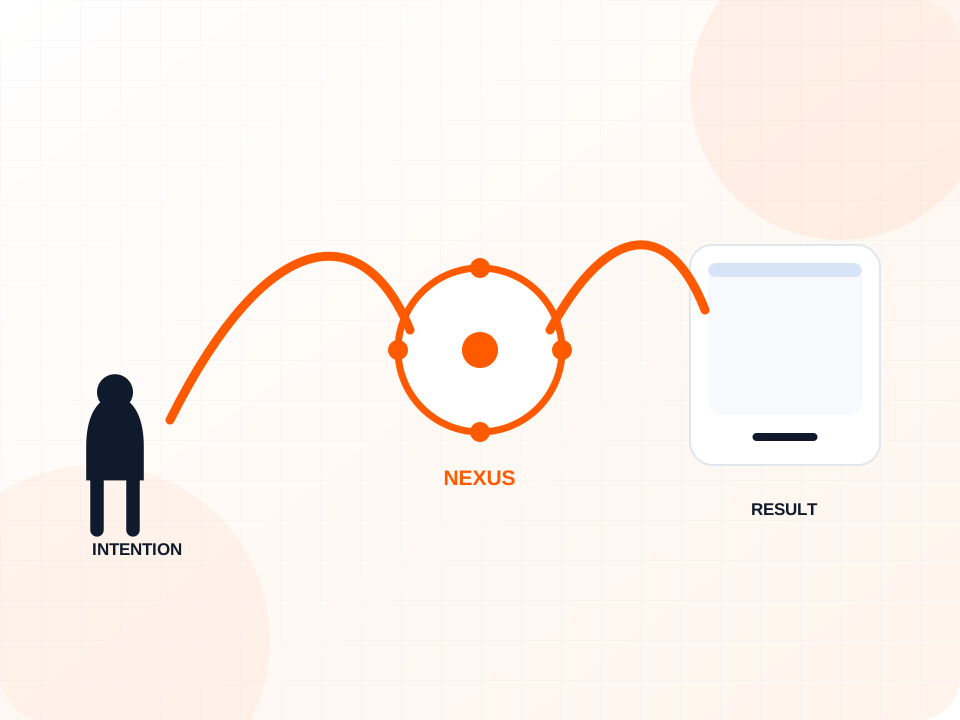
Nexus is an AI Command Bridge. You describe what should be true when the work is finished. Nexus understands the project, organises the connected work, coordinates the right capabilities and AI models, verifies the result and brings you the decisions that still require human judgement.
THE NORTH STAR

Move software complexity behind the command bridge.

People should not have to translate every business objective into menus, files, forms, application procedures and hand-offs. Nexus lets the objective remain the starting point.

Human

Outcome, priorities, policy and judgement

Nexus

Understand, organise, control, work and verify

Systems

Coordinated action and measurable result

THE SHIFT

AI advice becomes AI work.

Ordinary AI can explain the procedure. Nexus carries the objective through the authorised systems, keeps the work inspectable and returns a checked outcome.

AI ADVICE

“Here is how to do it.”

You receive an answer, a plan or code. You still locate the systems, repeat the operations, resolve conflicts and check the result.

AskExplainOperate manuallyReturn with new context
NEXUS WORK

“The work is complete. Two decisions need you.”

One objective becomes an organised mission with project memory, connected workstreams, authority checkpoints, independent review and evidence.

ObjectiveMissionWorkVerified result
THE DEFINITION

One command bridge across the work.

Nexus combines the parts that are usually fragmented across chats, applications, files, people and follow-up tasks.

Command bridge

Translates human goals into organised work across authorised digital capabilities.

Working environment

Keeps research, changes, checking, approvals and follow-up inside one continuing mission.

Project continuity

Retains useful terminology, rules, resources, history and previous decisions.

Expandable capability model

Adds specialist systems and abilities without changing the way the user gives an objective.

Different AI systems

Uses different providers and models for planning, research, building, specialist work, review and oversight inside one mission.

Selective authority

Separates what Nexus can do from what it is allowed to do in this project and mission.

MODEL-INDEPENDENT INTELLIGENCE

Different AIs. One project. One result.

Nexus separates the mission from the individual AI model. A company can use different providers, assign a stronger model to demanding work, use specialist intelligence where it adds value and let an independent model review the result. The project context, permissions, capabilities and mission history remain stable around them.

Coordinator

Keeps the objective, constraints and mission state coherent.

Researcher

Finds and organises information required to continue the work.

Builder

Creates or changes the requested output.

Reviewer

Checks whether the result matches the objective and project rules.

Specialist

Adds domain-specific judgement where a general worker is weaker.

Oversight

Examines sensitive, unusual and authority-related actions independently.

Choose the right intelligence

Nexus can route each role to the AI system best suited to the objective, domain and level of reasoning required.

Review AI with another AI

The worker and reviewer can use different models so important work is checked from an independent reasoning path.

Stronger models improve the mission

Smarter AI can produce better interpretation, plans, implementation, decisions and verification without changing how the user works with Nexus.

Keep the project when models change

Upgrading the intelligence does not discard the company’s rules, history, permissions, connected systems or accepted decisions.

THE ANATOMY OF A MISSION

Every kind of work uses the same understandable structure.

A website update, supplier import, customer resolution or cross-platform campaign can all be followed through objective, authority, work, decisions and result.

Objective

What should be true when the job is finished?

Scope

Which project, systems, records and people belong to the mission?

Constraints

What must remain unchanged? Which deadlines, rules and budgets matter?

Authority

What may Nexus inspect, prepare, execute, publish or decide?

Plan

Which workstreams, dependencies and review roles are required?

Progress

What is complete, active, blocked or waiting for a person?

Exceptions

Which cases fall outside the normal rules?

Verification

How is the actual result checked against the objective?

Result

What changed, what is complete and what still needs attention?

History

Which evidence and decisions become project memory?

NX-2401DS Overkappingen · Commercial website
Waiting for approval
Owner Commercial operations Authority Inspect, prepare and verify · publication approval required Elapsed 02m 14s RUN THIS IN YOUR COMPANY
OPERATIONAL LOGICWhat Nexus is actually doing behind the mission.
01Interpret & authoriseLoad the project rules, confirm the requested outcome and fix the permitted website scope.
02Connect & discoverOpen the authorised HTTPS, SFTP and content connections; identify the active web root and map URLs to their sources.
03Read & compareWalk the relevant files, pages, forms and records; compare the current state with the accepted project rules.
04Protect & executeCreate a snapshot and change manifest, then perform only the changes that fall inside mission authority.
05Read back & verifyRe-read server sources and public URLs; test the affected paths and compare the result with the objective.
06Record & continueStore evidence, decisions, changed items and rollback references in the continuing project history.
MISSION ACTIVITYConnections, inspection, actions and proof in one operational record.
15 / 15 events
YouObjective

Use this new pricing rule everywhere it belongs. Keep the current design, do not overwrite genuine exceptions, and ask me before anything is published.

COMMANDProject objective
2%
CoordinatorUnderstanding

I understand the requested outcome. I am fixing the scope, constraints, authority and evidence required before work begins.

INTERPRETScope · constraints · authority · success test
7%
Access ControllerAuthority mapped

Verified read access to all pricing sources and write access only to the approved page and product fields. Public publishing remains locked behind the named approval.

AUTHORISEProject permissions · capability scope · blocked actions
11%
Connection ManagerConnecting

Opened the authorised HTTPS and SFTP connections to the production domain. The public site root, mapped project folder and server identity were confirmed before inspection.

CONNECTWebsite endpoint + SFTP hosting + Product database
17%
Checkpoint WorkerCheckpointing

Captured a before-state package with file hashes, a product-data checkpoint and representative page renders so every later change can be compared or reversed.

CHECKPOINTBefore-state snapshot
23%
Project MemoryInvestigating

Project memory loaded the accepted installation-price rule, protected regional exceptions and the current publication boundary.

LOAD CONTEXTProject rules · history · accepted decisions
28%
Environment ExplorerReading environment

The crawler is traversing templates, generated pages, product records and sales documents. Inherited values, duplicates and regional overrides are being indexed separately.

INDEXFiles · pages · records · linked business data
35%
Website WorkerInvestigating

The website and product sources are being scanned as one pricing surface. 2,143 authorised items are in scope.

DISCOVERAuthorised working environment
42%
Data WorkerPlanning

326 items contain the old rule. 321 match the normal pattern; five use conflicting legacy logic and have been isolated.

PLANWork graph · normal cases · exceptions
52%
Data WorkerWorking

The Website Worker updated the routine page content while the Data Worker aligned the product records and generated a change manifest.

EXECUTEAuthorised change set
66%
ReviewerChecking

The Reviewer compared all 321 routine changes with the pricing rule, page structure and preserved content. No unrelated text changed.

VERIFYResult against objective and project rules
79%
OversightAuthority check

The mission remains inside the approved scope and authority. Sensitive actions outside that boundary remain locked.

CONTROLPermission and scope boundary
86%
NexusDecision

Five legacy cases need a business choice: keep the local exception, convert it to the new rule, or define a new regional rule.

DECIDEHuman attention queue
91%
NexusWaiting for approval

321 verified changes are ready. Five decisions remain. Publication is locked until approval.

RESULTVerified mission state
94%
Project MemoryHistory updated

Mission scope, evidence, decisions, changes and verification have been attached to the project for the next command.

STOREProject history · evidence · decisions
94%
DECISION REQUIREDResolve five legacy pricing conflicts
VERIFICATION
  • Every changed item matches the accepted pricing rule.
  • Page structure and unrelated content remain unchanged.
  • Product records and public page values agree.
  • Publication remains a separate authorised action.
VISIBLE MISSION STATES

The user always knows what Nexus is doing.

Clear states distinguish interpretation, preparation, execution, checking, decisions and completion.

Understanding

Clarifying the objective, success test and boundaries.

Investigating

Inspecting project information and identifying affected work.

Planning

Organising workstreams, dependencies, authority and review.

Preparing

Creating proposed changes and previews before sensitive action.

Working

Performing the actions authorised for this mission.

Checking

Comparing the actual result with the objective and project rules.

Waiting for you

Presenting one focused approval, preference or ambiguity.

Completed

Closing the mission with a verified result and attached evidence.

Partially completed

Recording the completed portion and the exact unresolved boundary.

Stopped

Protecting the project when a conflict, risk or authority boundary is reached.

PRODUCT PRINCIPLES

Eleven rules behind every Nexus mission.

These principles keep the product useful, controlled and understandable across completely different forms of digital work.

Outcome before procedure

The user states the desired result; Nexus carries the burden of organising the mission.

Capability is not authority

Knowing how to act never silently grants permission to act.

Human judgement is scarce

People are called for policy, ambiguity and responsibility—not routine volume.

Work remains inspectable

Objective, scope, progress, decisions and evidence stay visible.

A first answer is not proof

Independent checking is part of the mission, not an optional final comment.

Context persists

Projects preserve useful working knowledge across missions.

Uncertainty is explicit

Facts, assumptions, proposals and completed actions remain distinct.

Expand by capability

New systems become controlled abilities inside the same mission model.

Different AI models can work together

Nexus can use the best available intelligence for planning, specialist work and independent review.

Existing software remains valuable

Nexus coordinates the tools a company already relies on.

Completion is meaningful

The mission closes only after the actual result is checked and recorded.

ONE PLATFORM, SIX OPERATIONAL CENTERS

The command bridge stays coherent as the work expands.

Users move between the objective, project context, connected work, authority, review and evidence without losing the mission narrative.

Mission Center

Objectives, stage, progress, decisions, evidence and verified result.

Project Center

Context, rules, resources, previous decisions and open work.

Workspace Center

Files, websites, remote environments, documents and connected business systems.

Control Center

Authority, permissions, services, traces and operational policy.

Review Center

Independent checks, exceptions, before-and-after state and acceptance.

Capability Center

The specialist abilities available to each project and mission.

State the objective. Let Nexus organise the work.

Start with the result you want. Nexus turns it into one controlled mission across the project and systems involved.